%20by%20Payump.jpg)


Is HR Dead? 💀 Why AI Is Coming for Your Job (And How to Survive)
Let’s be real: The robots are here. 🤖 But are they coming for your HR job?
Not exactly.
If you’ve been scrolling LinkedIn lately, you’ve probably seen the doom-and-gloom posts.
"AI will replace us all!" "The end of Human Resources!" "Algorithms are the new managers!"
Take a deep breath. 🧘♀️
Artificial intelligence is fundamentally reshaping the HR profession, but probably not in the way you fear. From hiring and onboarding to performance management, AI is automating the stuff that makes you want to pull your hair out—endless spreadsheets, scheduling nightmares, and administrative busywork.
Check this out: A 2025 study by Gartner found that 26% of HR leaders are already operating AI-first models. Even bigger? IBM has successfully automated over 94% of its routine HR tasks through its AskHR platform.
Yet, despite this rapid transformation, the future of HR isn’t less human — it’s more strategic. The fear that machines will replace the "human" in human resources is being replaced by a new reality: AI is removing the boring stuff so you can focus on the people stuff.
This guide is your survival kit. We’re going deep on how AI is transforming human resources careers, the spicy new opportunities emerging in HR tech AI, and the skills you need to future-proof your paycheck.
Whether you're an HR Generalist looking to upskill or a job seeker eyeing a role in artificial intelligence in human resources, understanding this shift is no longer optional. It’s essential. Let’s dive in!
Why Is AI Shaking Up HR? (And Why That’s Good News)
HR sits right at the intersection of people and data — making it the perfect candidate for an AI glow-up. For decades, we've been data-rich but insight-poor. Artificial intelligence AI tools change that dynamic entirely.
AI in HR roles changes the game entirely.
The Big 4 Drivers of Change
Why is everyone talking about this? It’s not just a trend; it’s a total overhaul of the employee lifecycle.
- Efficiency ⚡️: Automating the repetitive stuff. Did you know the average recruiter spends 13 hours a week sourcing? AI models can now do that in seconds.
- Accuracy 🎯: No more human error in payroll or compliance.
- Personalisation 💜: Delivering an improved employee experience by giving every person a tailored career path.
- Cost Reduction 💸: Saving major cash on admin overhead.
Real-World Wins (Receipts Included)
The numbers don't lie. IBM’s internal rollout of AI assistants automated 94% of routine tasks. By letting AI handle the FAQs ("How do I reset my password?" "What is the dental plan?"), IBM’s humans got to focus on complex strategy and employee relations.
Similarly, Gartner reports that one in four HR teams now operate with an AI-first approach. This doesn't mean robots are running the show. It means we are leveraging AI capabilities to answer the question, "Can tech solve this?" so humans can focus on value.
Even industry legend Josh Bersin says HR isn’t “doomed”. In fact, he argues the profession is being re-engineered into a tech-empowered powerhouse. The "gatekeeper" model is dying 💀. The "architect" model is here.
The Tech Breakdown: Generative vs. Predictive AI
Before we talk about jobs, let's get our definitions straight. You’ll hear these terms in interviews, so you need to know the difference.
Predictive AI (The Fortune Teller 🔮)
This has been around for a while. It looks at historical data to guess what will happen next.
- HR Use Case: "Based on attendance records and survey scores, Employee X is 85% likely to quit in the next 3 months."
- Your Job: Intervention. You see the flag, and you go have a conversation to save that employee.
Generative AI (The Creator 🎨)
This is the new hotness (think ChatGPT). It creates new content based on prompts.
- HR Use Case: "Write a job description for a Senior React Developer that sounds fun, inclusive, and mentions our dog-friendly office."
- Your Job: The Editor. You prompt the AI, review the output, and add the human touch.
Working with AI: Your New Everyday Tools 🛠️
Wondering how to use AI in HR jobs without needing a coding degree? It’s easier than you think. Here is what the future of HR jobs AI looks like in practice:
1. Recruitment & Talent Acquisition 🕵️♀️
Recruiting is getting a massive upgrade. We aren't just posting ads anymore; we are overhauling entire recruiting processes.
- Sourcing: AI scans the web to find "passive" talent you’d never find manually.
- Screening: Platforms like HireVue use algorithms to assess skills rather than just keywords, streamlining the hiring process significantly.
- Engagement: Modern AI capabilities allow chatbots to answer candidate questions 24/7. No more ghosting!
2. Learning & Development (L&D) 📚
Goodbye, boring "one-size-fits-all" training videos!
- Skill Gap Analysis: AI looks at an employee's role vs. market trends and says, "Hey, you should learn this skill next!"
- Content Curation: Tools like Docebo can build a custom course for your team in minutes by scraping your internal documents and creating quizzes.
3. Employee Engagement & Retention ❤️
AI HR analytics are changing how we listen to people.
- Sentiment Analysis: Instead of a once-a-year survey, AI tools analyze (anonymized!) Slack sentiment or feedback forms to give you a "mood ring" for the company.
- Turnover Prediction: Predictive AI can spot patterns (like less email activity) and flag if someone is at risk of quitting before they hand in their notice.
4. The "AI Agent" (Your Virtual Assistant) 🤖
Imagine a chatbot that doesn't just answer questions but does things. This is the era of the AI agent. IBM uses these to handle support cases. An employee says "I need paternity leave," and the agent fills the forms, updates the calendar, and notifies the manager.
5. The Productivity Boost 📈
BCG research shows AI-augmented teams saw 30–40% productivity improvements. For you, this means the end of "admin fatigue." You get your day back!
📅 A Day in the Life: Before vs. After AI
Still not sure what this looks like? Let’s compare a typical Tuesday.
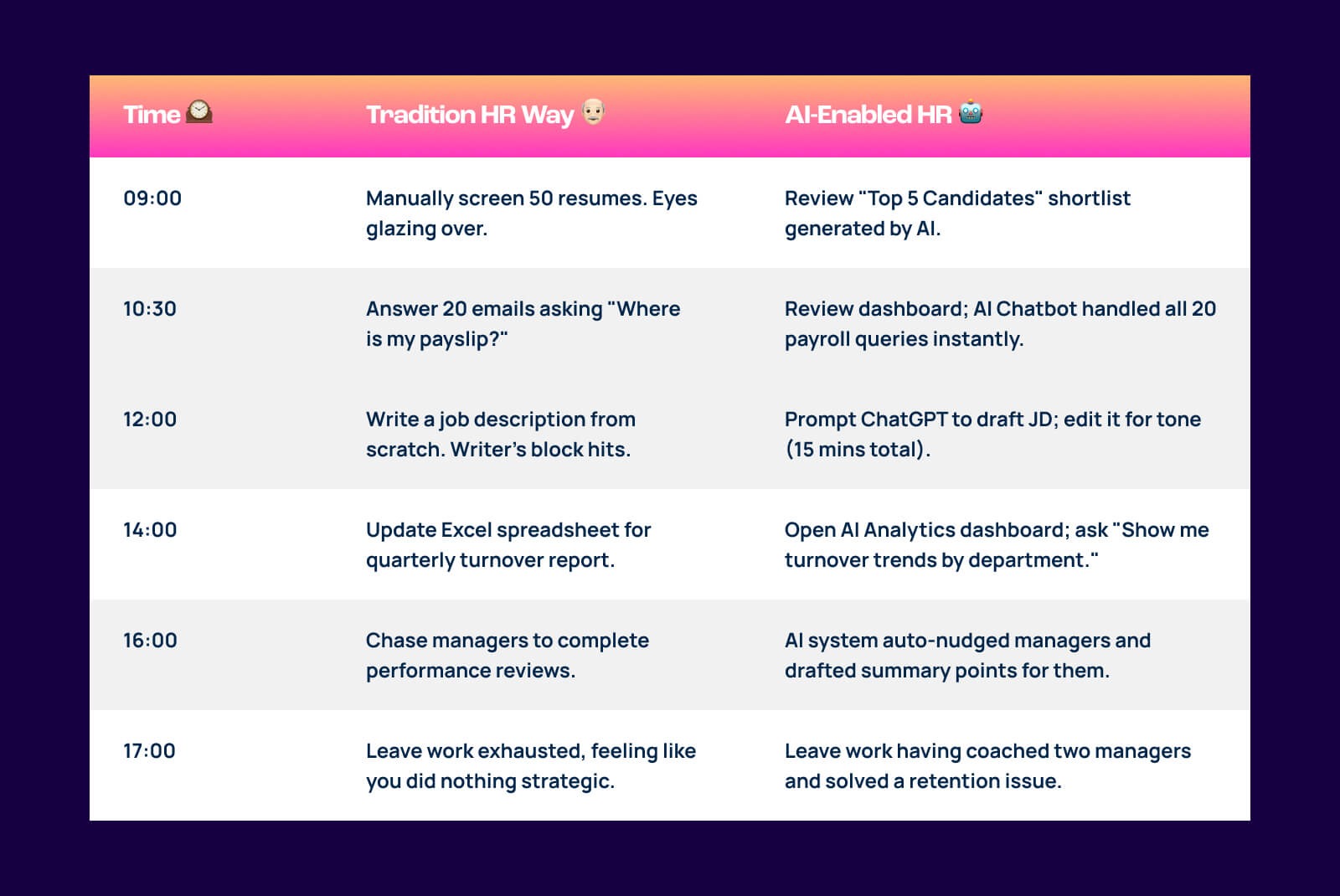
See the difference? AI buys you time. ⏳
New Career Paths: Where the Money Is
As tools evolve, so do the job titles. We are seeing a boom in HR tech AI roles that didn't exist five years ago. And yes, many of these are remote HR tech jobs!
The Salary Scoop
Disclaimer: Salaries vary by location and experience, but here is what the market is paying for these new skills.
1. HR Data Analyst / People Scientist 📊
- What they do: You tell the story behind the numbers. "Why is sales turnover high?" You find the answer using regression analysis and dashboards.
- Estimated Salary: $85,000 – $130,000
- Why it pays: Because you are directly saving the company money by predicting retention issues.
2. Talent Intelligence Specialist 🕵️♂️
- What they do: You use AI to map the external talent market. You tell the C-suite: "We should open our next office in Poland because there is a surplus of Python developers there."
- Estimated Salary: $90,000 – $140,000
- Why it pays: You are driving high-level business strategy.
3. AI Recruiting Strategist / HR Automation Lead 🤖
- What they do: You audit the bots. You configure the ATS, set up the chatbots, and ensure the automated workflows are actually working.
- Estimated Salary: $100,000 – $160,000
- Why it pays: You are a "Force Multiplier." You make the whole team 10x faster.
4. Head of Employee Experience (EX) ✨
- What they do: You use tech to design the "user journey" of the employee.
- Estimated Salary: $120,000 – $180,000+
- Why it pays: Retention is the new recruiting. Companies pay top dollar to keep people happy.
The Pivot Opportunity
💡 Pro Tip: This is a GOLDEN era for career pivoters. Traditional HR pros can move into tech roles by combining their people skills with new AI knowledge. You don't need to code; you just need to be a "tech-savvy human."
Skills to Future-Proof Your Paycheck
To crush it in AI in HR jobs, you need a T-shaped skill set: Deep human skills + broad tech knowledge.
Core Human Skills (Your Superpower)
Ironically, as machines do more, being human becomes MORE valuable.
- Storytelling: Data is boring without a story. You need to persuade stakeholders. "The data says turnover is up" is boring. "We are losing our best leaders because our onboarding process is broken" is a story.
- Empathy & Coaching: AI can flag a burnout risk, but only you can fix it with a coffee and a chat.
- Cultural Intelligence: Managing global remote teams? That’s all you.
- Change Management: Introducing AI scares people. Your job is to hold their hand and show them why it's a good thing.
Technical Fluency (Don't Panic!)
You don't need Python, but you do need "AI Literacy."
- Prompt Design: Learn how to talk to ChatGPT to get the best results. (Check out the Paybump Prompt Guide for this!)
- HR Analytics: Get comfortable reading dashboards. You don't need to build them, but you need to understand them.
- System Integration: Know how your ATS talks to your HRIS. Understanding the "flow of data" is a key skill.
Ethical Literacy
AI HR ethics is HUGE.
- Recognising Bias: You are the firewall. You need to ensure the AI isn't accidentally discriminating based on bad historical data.
- Fairness: Audit those tools regularly! "Trust but verify."
Upskilling Route:
- SHRM: Offers certification in People Analytics.
- Coursera: Check out "AI for People Professionals."
- Paybump Career Hub: We curate the best free resources for this!
Ethics, Governance & "The Computer Said No" 🚫
With great power comes great responsibility. Will AI replace HR managers? No, because AI can't go to jail for ethical failures—humans can.
The Bias Trap
One of the biggest risks in AI in HR is bias.
- The Scenario: You train an AI recruiting tool on the resumes of your top performers from the last 10 years.
- The Problem: If your top performers were mostly white men, the AI might "learn" that being male is a predictor of success. It might start downgrading female applicants.
- The Fix: You. HR professionals must audit the data inputs and constantly check the outputs for fairness.
Privacy & Compliance
HR manages the most sensitive data in the company: salaries, health records, home addresses.
AI in HR roles requires a strict adherence to data privacy laws (like GDPR or CCPA). You can't just plug employee health data into a public version of ChatGPT! You need to understand Entreprise Grade security.
Transparency and Explainable AI
"The computer said no" is not an acceptable answer to a rejected candidate. We need "explainable AI"—tools that can show why a decision was made. Transparency builds trust. HR leaders should co-own AI oversight with IT and compliance teams to align tools with organizational values.
The Lesson from IBM
IBM’s experience teaches us one thing: AI doesn't replace humans—it frees them. IBM's HR team didn't shrink; they were upskilled. They moved from "transaction processors" (paper pushers) to "trusted advisors."
The Resume Glow-Up: How to List AI Skills 📝
So, you've learned the skills. How do you put them on your CV so recruiters (and their bots) notice you?
Do NOT just write: "Proficient in Microsoft Office." (Yawn).
DO write this:
- "Leveraged Generative AI (ChatGPT) to reduce job description creation time by 40%."
- "Managed implementation of AI-driven recruiting platform (Eightfold), increasing candidate quality scores by 15%."
- "Utilized predictive analytics to identify retention risks, reducing department turnover by 10% YoY."
Keywords to sprinkle in:
- Workflow Automation
- Data-Driven Decision Making
- HRIS Optimization
- Prompt Engineering
- People Analytics
- Candidate Experience Design
How to Pivot from Traditional HR to HR Tech 🔀
Stuck in a generalist role? Want that HR tech AI salary? Here is your step-by-step roadmap.
Phase 1: The Audit (Week 1-2)
Look at your current job. Map your transferable skills.
- Policy Design → becomes Bot Governance (teaching the AI the rules).
- Engagement Strategy → becomes Employee Experience Design (using tech to drive engagement).
- Employee Relations → becomes People Insights (using data to solve conflict trends).
Phase 2: The Pilot (Week 3-6)
Don't wait for permission to be "techy."
- Start using ChatGPT to draft your emails and policies (scrubbing private data, of course!).
- Ask for access to your company's hiring data. Even if it's just Excel. Try to find a pattern.
- Document the win: "I used AI to reduce time-to-fill by 15%."
Phase 3: The Hunt (Week 7+)
Target job titles like:
- HR Automation Lead
- AI-Driven Talent Partner
- People Insights Manager
- HR Tech Implementation Specialist
Community is Key: Get involved in HR tech AI communities. Follow "HR Tech Weekly," join the Josh Bersin Academy, or participate in LinkedIn AI-HR groups. Networking there is where the hidden jobs are.
The Verdict: The Future is Bright (and Human) ✨
The HR function is evolving into a strategic nerve centre powered by data and automation. The future of HR jobs AI is massive for those who adapt.
We will see fewer "HR Administrators" and more "Workforce Architects." Remote HR tech jobs will continue to expand globally, opening access to cross-border teams and allowing HR professionals to work for global tech giants from anywhere.
As Josh Bersin puts it, “AI will make HR more human than ever — because it will remove the admin that holds people back.”
From HR to People Science 🧬
AI isn’t replacing HR — it’s redefining it. The HR professionals who thrive in the next decade will be those who harness technology to deliver deeper insights, fairer outcomes, and more meaningful work experiences. The role of HR is evolving — from gatekeeper to guide, from administrator to architect of human potential.
Ready to future-proof your HR career?
Explore the Paybump Career Hub for HR tech job leads, AI training resources, and practical guides to thriving in the digital workplace. 🚀 Sign up for the Paybump newsletter to get weekly insights into AI, careers, and the future of people's work!
FAQs
Will AI replace HR professionals?
Not entirely. AI automates repetitive work like scheduling and screening but enhances human capabilities in decision-making, empathy, and strategy. HR roles are evolving, not disappearing.
Will AI replace HR managers?
AI can support HR managers with insights and analytics, but leadership, judgment, and culture-building remain human strengths that can’t be replicated.
What new jobs are emerging in AI-powered HR?
Expect demand for HR data scientists, AI recruiting strategists, and HR automation specialists — many available remotely or hybrid.
How can I start using AI in HR?
Begin with safe, explainable tools for screening, analytics, or learning (like Recruitee, Gloat, or Eightfold). Learn prompt-writing and data interpretation to increase your efficiency.
What are the ethical risks of AI in HR?
Bias, privacy, and accountability. HR must oversee ethical guardrails to ensure fairness and transparency in hiring and performance management.
Is HR still a good career in the age of AI?
Yes — but it’s changing fast. The most successful professionals will blend people expertise with data-driven, AI-supported skills.